Tuesday, November 5, 2013

Our outcomes are world-class but the costs are exorbitant

From The Myth of Americans' Poor Life Expectancy by Avik Roy.
Life expectancy is an appealingly simplistic, but deeply flawed, way to think about the quality of a country’s health-care system. After all, shouldn’t good health care make you live longer? Well, yes, but. The problem, of course, is that there are many factors that affect life expectancy.

[snip]

If you really want to measure health outcomes, the best way to do it is at the point of medical intervention. If you have a heart attack, how long do you live in the U.S. vs. another country? If you’re diagnosed with breast cancer? In 2008, a group of investigators conducted a worldwide study of cancer survival rates, called CONCORD. They looked at 5-year survival rates for breast cancer, colon and rectal cancer, and prostate cancer. I compiled their data for the U.S., Canada, Australia, Japan, and western Europe. Guess who came out number one?

[snip]

Another point worth making is that people die for other reasons than health. For example, people die because of car accidents and violent crime. A few years back, Robert Ohsfeldt of Texas A&M and John Schneider of the University of Iowa asked the obvious question: what happens if you remove deaths from fatal injuries from the life expectancy tables? Among the 29 members of the OECD, the U.S. vaults from 19th place to…you guessed it…first. Japan, on the same adjustment, drops from first to ninth.
I think Roy's points are well taken. I have repeatedly made the argument that when making comparisons, you have to ensure that you are comparing like-to-like (The Texas-Wisconsin Paradox and intergenerational income mobility and Every one of those common assumptions is simplistic, misguided, or downright wrong. My conclusion is that because the US is so large, so multicultural and so exceptional, it often is highly misleading to look at surface comparisons without understanding the degrees by which countries differ from one another.

For example, I think it is reasonably clear that, when making apples-to-apples comparisons on education, the US is inefficient (much more is spent per outcome) but also much more effective (generally the highest outcomes on a homogenous basis). See US Education: Expensive and ineffective? Not so fast and Americans living intensely.

What Roy is suggesting is something similar for health; that if we want to measure effectiveness, we have to look at health outcomes by intervention rather than overall averages of mortality. In other words, we have to compare apples-to-apples. Nothing particularly controversial about that except that the outcomes are so different from the message we are accustomed to hearing; that for a given health intervention, the US is at the top of the league for positive, effective and desirable outcomes.

What this suggests is that, when taking into account the multiculturalism of the US and comparing apples-to-apples, that in three crucial policy areas, education, health, and welfare (see Income Inequality, Positional Goods, Identity Multiplicity, and Functional Convergence), the US is producing highly effective outcomes that place it at the top of international performance tables when comparing like-to-like. The exceptional effectiveness is achieved, however, with dramatically poor efficiency: Our outcomes are world-class but the costs are exorbitant and perhaps unsustainable.

So we know we can achieve excellence, as we are doing, but what we need to learn is how to improve the efficiency of achievement. Effectiveness - Done; Efficiency - Work in Progress.

What the apples-to-apples comparisons are doing is forcing us into a very uncomfortable corner. IF, in a multicultural country such as the US, we acknowledge that different cultures (the average amalgam of Knowledge, Experience, Skills, Values and Behaviors for each self-identified group) yield different outcomes for a given system or a given exogenous shock, then the fastest way to achieve standard outcomes is to do one of two things.

We can either change the system so that we achieve comparable results for all groups by treating each group differently OR we can synthesize the culture of all groups around the best performing culture.

Under a pluralistic system founded on individual agency, accountability and freedoms, neither approach is feasible. But even if it were, is there actually a preferred choice between the two? I suspect not, both seem anathema.


Monday, November 4, 2013

The ultimate good desired is better reached by free trade in ideas

I can't believe I haven't referenced Justice Oliver Wendell Holmes' dissent in Abrams et al v. United States but apparently I haven't.

One of history's clearer calls for universal acknowledgement of freedom of speech even in the most fraught of circumstances. Too many people seem comfortable with the proposition that speech should only be free so long as no one feels slighted by it.
If you have no doubt of your premises or your power and want a certain result with all your heart you naturally express your wishes in law and sweep away all opposition. To allow opposition by speech seems to indicate that you think the speech impotent, as when a man says that he has squared the circle, or that you do not care whole-heartedly for the result, or that you doubt either your power or your premises. But when men have realized that time has upset many fighting faiths, they may come to believe even more than they believe the very foundations of their own conduct that the ultimate good desired is better reached by free trade in ideas — that the best test of truth is the power of the thought to get itself accepted in the competition of the market, and that truth is the only ground upon which their wishes safely can be carried out. That at any rate is the theory of our Constitution. It is an experiment, as all life is an experiment. Every year if not every day we have to wager our salvation upon some prophecy based upon imperfect knowledge. While that experiment is part of our system I think that we should be eternally vigilant against attempts to check the expression of opinions that we loathe and believe to be fraught with death, unless they so imminently threaten immediate interference with the lawful and pressing purposes of the law that an immediate check is required to save the country.

Platonic fold: the place where our Platonic representation enters into contact with reality

Nassim Nicholas Taleb, The Black Swan, a book which is chock-a-block full of interesting ideas, some novel, some fresh elaborations or perspectives on already well-established ideas. Just came across an ungated version of the book's glossary which captures some of the central ideas. A sampling -
Bildungsphilister: a philistine with cosmetic, nongenuine culture. Nietzsche used this term to refer to the dogma-prone newspaper reader and opera lover with cosmetic exposure to culture and shallow depth. I extend it to the buzzword-using researcher in nonexperimental fields who lacks in imagination, curiosity, erudition, and culture and is closely centered on his ideas, on his “discipline.” This prevents him from seeing the conflicts between his ideas and the texture of the world.

Empty-suit problem (or “expert problem”): Some professionals have no differential abilities from the rest of the population, but for some reason, and against their empirical records, are believed to be experts: clinical psychologists, academic economists, risk “experts,” statisticians, political analysts, financial “experts,” military analysts, CEOs,
et cetera. They dress up their expertise in beautiful language, jargon, mathematics, and often wear expensive suits.

Epistemic arrogance: Measure the difference between what someone actually knows and how much he thinks he knows. An excess will imply arrogance, a deficit humility. An epistemocrat is someone of epistemic humility, who holds his own knowledge in greatest suspicion.

Locke’s madman: someone who makes impeccable and rigorous reasoning from faulty premises—such as Paul Samuelson, Robert Merton the minor, and Gerard Debreu—thus producing phony models of uncertainty that make us vulnerable to Black Swans.

Narrative discipline: the discipline that consists in fitting a convincing and well-sounding story to the past. Opposed to experimental discipline. Narrative fallacy: our need to fit a story or pattern to a series of connected
or disconnected facts. The statistical application is data mining.

Platonic fold: the place where our Platonic representation enters into contact with reality and you can see the side effects of models.

Platonicity: the focus on those pure, well-defined, and easily discernible objects like triangles, or more social notions like friendship or love, at the cost of ignoring those objects of seemingly messier and less tractable structures.

Sunday, November 3, 2013

Not in sweet sins but in a dreary flickering of the mind over it knows not what and knows not why

From The Screwtape Letters by C.S. Lewis, h/t Ann Althouse. Letter XII.

Recalling that the context is one of the lesser devil's writing to his nephew, Screwtape, offering advice on how to lead people astray and away from the Enemy (God).

As this condition becomes more fully established, you will be gradually freed from the tiresome business of providing Pleasures as temptations. As the uneasiness and his reluctance to face it cut him off more and more from all real happiness, and as habit renders the pleasures of vanity and excitement and flippancy at once less pleasant and harder to forgo (for that is what habit fortunately does to a pleasure) you will find that anything or nothing is sufficient to attract his wandering attention. You no longer need a good book, which he really likes, to keep him from his prayers or his work or his sleep; a column of advertisements in yesterday's paper will do. You can make him waste his time not only in conversation he enjoys with people whom he likes, but in conversations with those he cares nothing about on subjects that bore him. You can make him do nothing at all for long periods. You can keep him up late at night, not roistering, but staring at a dead fire in a cold room. All the healthy and outgoing activities which we want him to avoid can be inhibited and nothing given in return, so that at last he may say, as one of my own patients said on his arrival down here, "I now see that I spent most of my life in doing neither what I ought nor what I liked". The Christians describe the Enemy as one "without whom Nothing is strong". And Nothing is very strong: strong enough to steal away a man's best years not in sweet sins but in a dreary flickering of the mind over it knows not what and knows not why, in the gratification of curiosities so feeble that the man is only half aware of them, in drumming of fingers and kicking of heels, in whistling tunes that he does not like, or in the long, dim labyrinth of reveries that have not even lust or ambition to give them a relish, but which, once chance association has started them, the creature is too weak and fuddled to shake off.

Saturday, November 2, 2013

Baseless panics and consensus opinions

An interesting exercise in Global Warming Analogies Forecasting Project by J. Scott Armstrong and Kesten C. Green. In the context of the sustained IPCC alarm over global warming, the researchers ask,
Have there been other situations that involved widespread alarm over predictions of serious harm that could only be averted at considerable cost? We are particularly interested in alarms endorsed by experts and accepted as serious by relevant authorities.”
Here is the list Armstrong and Green compiled of analogous scares. An interesting mix. Just eyeballing the list without any research (and omitting the first couple from 1798 and 1865), some I just don't know enough about to judge the status (6), some weren't issues at all or the impact was much less than anticipated (14), and some really were significant (4).
Analogies to the alarm over dangerous manmade global warming

1 Population growth and famine (Malthus) 1798
2 Timber famine economic threat 1865
3 Uncontrolled reproduction and degeneration (Eugenics) 1883
4 Lead in petrol and brain and organ damage 1928
5 Soil erosion agricultural production threat 1934
6 Asbestos and lung disease 1939
7 Fluoride in drinking water health effects 1945
8 DDT and cancer 1962
9 Population growth and famine (Ehrlich) 1968
10 Global cooling; through to 1975 1970
11 Supersonic airliners, the ozone hole, and skin cancer, etc. 1970
12 Environmental tobacco smoke health effects 1971
13 Population growth and famine (Meadows) 1972
14 Industrial production and acid rain 1974
15 Organophosphate pesticide poisoning 1976
16 Electrical wiring and cancer, etc. 1979
17 CFCs, the ozone hole, and skin cancer, etc. 1985
18 Listeria in cheese 1985
19 Radon in homes and lung cancer 1985
20 Salmonella in eggs 1988
21 Environmental toxins and breast cancer 1990
22 Mad cow disease (BSE) 1996
23 Dioxin in Belgian poultry 1999
24 Mercury in fish effect on nervous system development, 1; 2 2004
25 Mercury in childhood inoculations and autism 2005
26 Cell phone towers and cancer, etc. 2008
It is great when you deal with concrete examples rather than abstractions because it forces much greater nuance and understanding. For example, take Mad Cow Disease. I was in Britain when that first came to public attention and the panic was palpable as people realized just how long the incubation period was and how big the numbers might get in terms of people who might fall prey to it. As it turned out, the disease was real and I would argue that during the longish period of uncertainty, people were right to be concerned, but in the event, the population affected turned out to be very small.

The net is that more than half the sample panics turned out not to be real or turned out to be far smaller in scale than initial expert forecasts anticipated. Some of those panics that turned out not to be real (DDT and cancer, possibly acid rain, possibly BSE, etc.) had very large real-world costs in lives and money when they were acted on with conviction but not validity.

This is very much a work in progress with much potential disputation. However, it is a useful reminder that many beliefs held with conviction or forecasts made with certainty are faith-based assumptions and not fact-based consensus.

The market may not teach people to trust, but it certainly makes it easier for people to do so

Ricardo Hausmann, a Venezuelan developmental economist and Harvard professor, has a provocative post, The Tacit-Knowledge Economy.

He starts by laying out a reasonably well known and documented phenomenon that is not widely discussed but very intriguing.
Almost all rich countries are rich because they exploit technological progress. They have moved the bulk of their labor force out of agriculture and into cities, where knowhow can be shared more easily. Their families have fewer children and educate them more intensively, thereby facilitating further technological progress.

Poor countries need to go through a similar change in order to become rich: reduce farm employment, become more urban, have fewer children, and keep those children that they have in school longer. If they do, the doors to prosperity will open. And isn’t that already happening.

Let us compare, for example, Brazil in 2010 with the United Kingdom in 1960. Brazil in 2010 was 84.3% urban; its fertility rate was 1.8 births per woman; its labor force had an average of 7.2 years of schooling; and its university graduates accounted for 5.2% of potential workers. These are better social indicators than the United Kingdom had in 1960. At that time, the UK was 78.4% urban; its fertility rate was 2.7; its labor force had six years of schooling on average, and its university graduates accounted for less than 2% of potential workers.

Brazil is not a unique case: Colombia, Tunisia, Turkey, and Indonesia in 2010 compare favorably to Japan, France, the Netherlands, and Italy, respectively, in 1960. Not only did these countries achieve better social indicators in these dimensions; they also could benefit from the technological innovations of the past half-century: computers, cellphones, the Internet, Teflon, and so on. This should allow higher productivity than was feasible in 1960.

So today’s emerging-market economies should be richer than today’s advanced economies were back then, right?

Wrong – and by a substantial margin. Per capita GDP at constant prices was 140% higher in Britain in 1960 than in Brazil in 2010. It was 80% higher in Japan back then than in Colombia today, 42% higher in old France than in current Tunisia, 250% higher in the old Netherlands than in current Turkey, and 470% higher in old Italy than in current Indonesia.
There is actually a lot to discuss and dispute in the premises but let's let that stand for the moment. What is Hausmann's explanation?
The key to this puzzle is tacit knowledge. To make stuff, you need to know how to make it, and this knowledge is, to a large extent, latent – not available in books, but stored in the brains of those who need to use it.

Getting it there is really tough. Tacit knowledge is acquired mostly through learning by doing. That is how we train musicians, barbers, doctors, and scientists. Consider how long it takes an adult to learn to speak a language or a musician to master the violin.

Moreover, tacit knowledge is vast and growing, so that only a miniscule fraction of it fits in anybody’s head. But most products require much more knowledge than fits in anybody’s head, so that making them requires teams of people with different pieces of knowledge, not unlike a symphonic orchestra.
He concludes,
The bottom line is that urbanization, schooling, and Internet access are woefully insufficient to transmit effectively the tacit knowledge required to be productive. That is why today’s emerging markets are so much less productive than rich countries were in 1960, even though the latter were less urban, had higher birth rates and less formal schooling, and used much older technologies.

The policy implications are clear. Knowhow resides in brains, and emerging and developing countries should focus on attracting them, instead of erecting barriers to skilled immigration. They should tap into their diasporas, attract foreign direct investment in new areas, and acquire foreign firms if possible. Knowledge moves when people do.
An interesting proposition and one that likely has some merit though it is only skimpily argued and supported in the brief post.

What is this tacit knowledge of which Hausmann speaks? I understand the general idea but I don't see a rigorous definition in either his post or in the links. It sounds an awful lot like culture and/or E.D. Hirsch' concept of Cultural Literacy, both of which I think are meritorious arguments.

However it is defined, I think there are probably several aspects of tacit knowledge which are causative of economic productivity but which are not discussed by Hausmann. For example, one aspect of tacit knowledge might be a recognition of the distinction between the possible and the magical. By this I mean that there is great value in knowing that something is real and feasible versus believing something is possible. Thomas Kuhn discussed this with different terminology in The Structure of Scientific Revolutions. He spoke of paradigm shifts when the embedded view of something changes dramatically and quickly. Whether we are speaking of cultural habits, geographical exploration, or scientific discoveries, it is common for there to be a long period of stasis, but once something is demonstrated as real, there is a sudden flood.

The Portuguese spent a century poking around the South Atlantic trying to find a way to the East Indies and the spice trade. The exploration was perilous, intermittent and proceeded in fits and starts. Once Vasco da Gama rounded the Cape of Good Hope, all of sudden there was a flood of ships making a beeline eastwards. Knowing that there was actually a feasible route changed the dynamic and numbers dramatically.

I think tacitly "knowing" what is really feasible, whether any particular individual understands the mechanics, is one of the great privileges of more modern economies.

I happen to be reading The Wisdom of Crowds by James Surowiecki at the moment, Chapter 3. It is a well established fact that countries with strong cultures of intra-group trust tend to have much stronger, more durable and longer sustained economic productivity than do other cultures. His Chapter 3 is a particularly good discussion of the development and benefit of trust in advanced economies in that trust permits a much more productive approach towards problems of both coordination and cooperation.
In any case, what the researchers found was that in every single society there was significant deviation from the purely rational strategy. But the deviations were not all in the same direction, so there were significant differences between the cultures. What was remarkable about the study, though, was this: the higher the degree to which a culture was integrated with the market, the greater the level of prosociality. People from more market-oriented societies made higher offers in the dictator game and the ultimatum game, cooperated in the public-goods game, and exhibited strong reciprocity when they had the chance. The market may not teach people to trust, but it certainly makes it easier for people to do so.
So the question becomes, if there is merit to this trail of cognitive bread crumbs towards productivity, do ideologies or world views that foster divisiveness and distrust, in turn hamper the productivity of the adherents of that ideology?

I am guessing likely so.

Friday, November 1, 2013

There are no whole truths; all truths are half-truths

From Dialogues of Alfred North Whitehead (1954). From the prologue.
There are no whole truths; all truths are half-truths. It is trying to treat them as whole truths that plays the devil.
From Chapter 17.
Intelligence is quickness to apprehend as distinct from ability, which is capacity to act wisely on the thing apprehended.


Thursday, October 31, 2013

Captain Justice, Guardian of the Realm and Leader of the Resistance, primarily asks that the Court deny the State's motion

These seem petulant mean spirited times with unsupported assertions made left, right , and center seeking to coerce free citizens in one set of actions and proscribe others. Wearying. And then along comes a bright wit to remind us that mockery and humor is often the best antidote.

You never can be sure about things you find on the internet but I have confirmed the names and locations as real. This does appear to be a real sequence of events.

It has come to this. The Assistant District Attorney General for the State of Tennessee sought the following ruling from the Circuit Criminal Court of Williamson County, Tennessee.
The State has noticed in the past few years that it has become commonplace during trials for attorneys for defendants, and especially Mr. Justice, to refer to State's attorneys as "the Government" repeatedly during trial. The State believes that such a reference is used in a derogatory way and is meant to make the State's attorneys seem oppressive and to inflame the jury. The jury members are instructed and take an -oath that they will decide the case impartially on the evidence presented. Attempts to characterize the State's attorney have no place in the courtroom. Attempts to make the jury dislike the State's attorney have no place in the courtroom.

Wherefore, the State asks for a ruling that during trial the attorney for Defendant refer to the State's attorney by title or name. Those titles or names are General Rettig, the Assistant District Attorney General, Mrs. Rettig, or simply the State of Tennessee.
It is fun to play with this. On one level it is distressing seeing professionals behaving as grade school children - "make him quit calling me names."

On another level it is distressing that Government has become so clearly a pejorative word that it is probably a legitimate concern that the term could be considered prejudicial in some fashion.

On yet another level, it is distressing that the Government, with all its advantages and resources, should seek to tilt the field further in its favor by circumscribing speech.

But Drew Justice (yes he's a real attorney and that is his real name), the plaintiff's attorney appears to have the right attitude. Treat bullying and hauteur and seekers of special privilege with derision and mockery. His response to the State's motion is here. He takes a couple of paragraphs at the lead to dispatch the State's position on legal grounds. But he doesn't then stop there.
Should this Court disagree, and feel inclined to let the parties basically pick their own designations and ban words, then the defense has a few additional suggestions for amending the speech code. First, the Defendant no longer wants to be called "the Defendant." This rather archaic term of art, obviously has a fairly negative connotation. It unfairly demeans, and dehumanizes Mr. Donald Powell. The word "defendant" should be banned. At trial, Mr. Powell hereby demands be addressed only by his full name, preceded by the title "Mister." Alternatively, he may be called simply "the Citizen Accused." This latter title sounds more respectable than the criminal "Defendant." The designation "That innocent man" would also be acceptable.

Moreover, defense counsel does not wish to be referred to as a "lawyer," or a "defense attorney." Those terms are substantially more prejudicial than probative. See Tenn. R. Evid. 403. Rather, counsel for the Citizen Accused should be referred to primarily as the "Defender of the Innocent." This title seems particularly appropriate, because every Citizen Accused is presumed innocent. Alternatively, counsel would also accept the designation "Guardian of the Realm."Further, the Citizen Accused humbly requests an appropriate military title for his own representative, to match that of the opposing counsel. Whenever addressed by name, the name "Captain Justice" will be appropriate. While less impressive than "General," still, the more humble term seems suitable. After all, the Captain represents only a Citizen Accused, whereas the General represents an entire State.

Along these same lines, even the term "defense" does not sound very likeable. The whole idea of being defensive, comes across to most people as suspicious. So to prevent the jury from being unfairly misled by this ancient English terminology, the opposition to the Plaintiff hereby names itself "the Resistance." Obviously, this terminology need only extend throughout the duration of the trial — not to any pre-trial motions. During its heroic struggle against the State, the Resistance goes on the attack, not just the defense.

WHEREFORE, Captain Justice, Guardian of the Realm and Leader of the Resistance, primarily asks that the Court deny the State's motion, as lacking legal basis. Alternatively, the Citizen Accused moves for an order in limine modifying the speech code as aforementioned, and requiring any other euphemisms and feel-good terms as the Court finds appropriate.

Law is always a strange meeting place between philosophy and reality

There was a Supreme Court case on Tuesday the 15th, Schuette v. Coalition to Defend Affirmative Action, yet another in defense of Affirmative Action. This one is particularly convoluted and is probably best summarized by Ilya Somin and Lyle Denniston.

Basically, the voters of Michigan passed a state constitutional amendment by 58-42% banning discrimination or preferential treatment on the basis of "race, sex, color, ethnicity or national origin." It is anticipated that this will have the most immediate impact on Universities. That has put the ACLU and other parties in the case in the peculiar, to my mind, position of having to argue that it should be permissible for the government to discriminate and provide preferential treatment on the basis of race, sex, color, ethnicity or national origin. Law is always a strange meeting place between philosophy and reality.

What caught my eye in the reports was an exchange between one of the lead attorneys and the Justices which is the first time I have seen academic hothouse ideology front and center in a national forum. Specifically, there has long been a popular parlance in the groves of academe regarding the inherently racist nature of America (government and culture) and the pervasive influence of "the Patrimony." Both of these get short handed into references to privilege; white privilege and male privilege specifically. Worst of all, white male privilege.

In many ways, this particular world view, as far as I can tell, has been treated as an eccentric child. On the rare occasions that it is rolled out, polite responsible company avert their eyes, talk louder, and do their best to ignore the antics. The embarrassment for people so steeped in this world view is that it is so patently shallow and unsupported by reality. The struggles to make the ideology fit even the most rudimentary data are a herculean game of twister. A few writers such as the economist Thomas Sowell, seemingly as a form of civic duty, keeps knocking down the arguments but facts are of little consequence where creed and belief are involved.

But this is the first time I have seen the academic vision of privilege out in public in a reputable forum, in this instance, before the justices of the Supreme Court. Shanta Driver was one of the lead attorneys for those seeking to overturn the Michigan amendment outlawing discrimination.
Driver: We ask this Court to uphold the Sixth Circuit decision to reaffirm the doctrine that's expressed in Hunter-Seattle, and to bring the 14th Amendment back to its original purpose and meaning, which is to protect minority rights against a white majority, which did not occur in this case.

Scalia: My goodness, I thought we've--we've held that the 14th Amendment protects all races. I mean, that was the argument in the early years, that it protected only--only the blacks. But I thought we rejected that. You--you say now that we have to proceed as though its purpose is not to protect whites, only to protect minorities?

Driver: I think it is--it's a measure that's an antidiscrimination measure.

Scalia: Right.

Driver: And it's a measure in which the question of discrimination is determined not just by--by power, by who has privilege in this society, and those minorities that are oppressed, be they religious or racial, need protection from a more privileged majority.

Scalia: And unless that exists, the 14th Amendment is not violated; is that right? So if you have a banding together of various minority groups who discriminate against--against whites, that's okay?

Driver: I think that--

Scalia: Do you have any case of ours that propounds that view of the 14th Amendment, that it protects only minorities? Any case?

Driver: No case of yours.
I don't think it was a particularly successful outing.

Wednesday, October 30, 2013

This experience suggests that more notable than any loss of credibility was a simple failure to achieve debt reduction

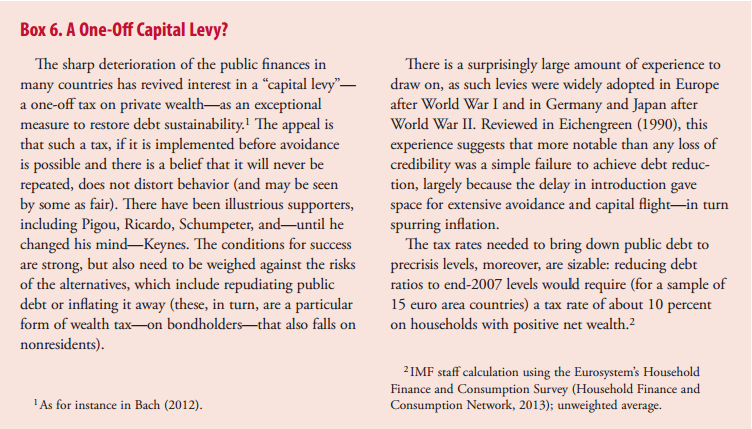
From A One-Off Capital Levy? from the Financial Times. Profligate governments also tend to be crisis driven governments. They don't plan, they simply address the problem in front of them. When they get close to the cliff they take extraordinary actions which almost inevitably backfire as described below. The root cause is almost always profligate spending and poor planning. Increasing real growth by a single percentage point (reducing regulatory issues, tax burdens, etc.) and balancing the budget (so that you keep from making the financial hole deeper) are the best ways to solve the problem of weak government finances but almost every government will do everything it can to keep from making those hard decisions. As we have seen most recently in Cyprus, Poland and Greece, there is a strong inclination to simply confiscate the wealth of citizens to "solve" the problem. But does it work?
There is a surprisingly large amount of experience to draw on, as such levies were widely adopted in Europe after World War I and in Germany and Japan after World War II. Reviewed by Eichengreen (1990), this experience suggests that more notable than any loss of credibility was a simple failure to achieve debt reduction, largely because the delay in introduction gave space for extensive avoidance and capital flight - in turn spurring inflation.

The tax rates needed to bring down public debt to precise levels, moreover, are sizeable: reducing debt ratios to end-2007 levels would require (for a sample of 15 euro area countries) a tax rate of about 10 percent on households with positive net wealth.
Yikes! And that isn't to get rid of the accumulated debt, that's only to bring it back to the earlier unacceptable levels.